
Are Solar Flagpole Lights Worth It for Your Pole?
A flag that comes down at sunset needs no light at all. But if you prefer to fly Old Glory around the clock, proper illumination becomes part of displaying it with the respect it deserves. So, are solar flagpole lights worth it? For many homeowners and small properties, the answer is yes - provided the pole has strong sun exposure and you choose a light sized for the job.
Solar lighting is not a magic add-on that performs the same in every yard, season, or climate. A quality unit can make nighttime flag display simple, clean, and affordable. The wrong unit, installed in shade or expected to light an oversized flag from an extreme height, can leave you disappointed by midnight.
Why flagpole lighting matters
The U.S. Flag Code says the flag should ordinarily be displayed only from sunrise to sunset, but it may be displayed 24 hours a day if properly illuminated during darkness. For homeowners, businesses, schools, and public facilities, that makes lighting the practical choice when the flag is intended to remain raised overnight.
A well-lit flag also looks better. It gives the pole a finished appearance after dark, makes a front entrance or business property easier to recognize, and avoids the hassle of lowering and raising the flag every day. Solar flagpole lights offer those benefits without trenching wire, hiring an electrician, or adding another fixture to the monthly power bill.
Are solar flagpole lights worth it? It depends on the installation
The best candidates for solar lighting are freestanding flagpoles in open, sunny locations. Think of a pole installed in the front yard, beside a driveway, at a business entrance, or in an open municipal lawn. If the solar panel receives several hours of direct sunlight, a good light can charge fully during the day and turn itself on at dusk.
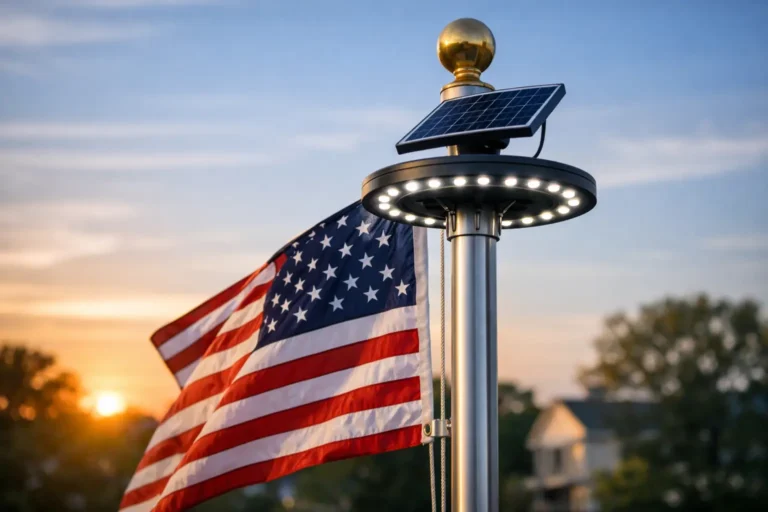
They are especially worthwhile for a 15- to 25-foot residential flagpole where running electrical service would be costly or unattractive. Most pole-mounted solar lights install below the ball or ornament at the top of the pole and direct light downward onto the flag. Once installed, they operate automatically, which is exactly what many customers want.
The value is less clear in a heavily wooded yard, on the north side of a tall building, or in places that receive limited winter sunlight. A solar light cannot store power it never receives. If the panel is shaded for much of the day, the light may run only a few hours after dusk, even if the product itself is well made.
For a commercial property, school, government site, or any location where dependable all-night illumination is non-negotiable, wired lighting may be the better long-term answer. It costs more to install, but it delivers consistent output through storms, cloudy stretches, and short winter days.
What a solar flagpole light does well
Solar flagpole lighting earns its place because it removes the difficult part of adding light: getting power to the pole. There is no underground cable to bury, no outlet to protect, and no timer to program. The light charges by day, senses darkness, and operates on its own.
That simplicity matters for homeowners who want a dignified display without turning a lighting project into an excavation project. It also makes solar a practical option for remote areas of a property, entrance monuments, and locations where pavement, landscaping, or irrigation would make trenching expensive.
Most quality solar lights use LED bulbs. LEDs use relatively little stored energy, create a bright white light, and last far longer than older bulb styles. Their low energy draw gives a properly charged battery a reasonable chance of carrying the light through the night under favorable conditions.
Solar units are also easier to service. When the battery eventually loses capacity, it can generally be replaced without touching the pole foundation or electrical system. Keeping the panel clean and occasionally checking the mounting hardware are usually the main maintenance tasks.
The trade-offs buyers should understand
A solar light is only as reliable as its available sunlight and battery capacity. Summer performance is usually excellent because days are long and sunlight is strong. In winter, shorter days, snow cover, persistent clouds, and lower sun angles can reduce charging time. Northern climates feel this difference more sharply than southern locations.
Brightness is another consideration. A modest solar fixture may be perfectly suitable for a 3-by-5-foot flag on a 20-foot pole. That same fixture may not provide the broad, even illumination expected for a large flag flying from a 35-foot commercial pole. The goal is not merely to see a glowing spot near the top of the pole. The full flag should be visibly illuminated.
Pole movement can matter as well. A top-mounted light rides with the pole and may move in high wind, especially on a telescoping pole or a site exposed to frequent gusts. Choose equipment designed for your pole style, flag size, and local wind conditions, and make sure the added fixture does not interfere with the pulley system, truck assembly, or rotating hardware.
Finally, not every solar product sold online is built for serious outdoor use. Low-priced lights often make impressive claims about brightness and run time but use small panels, limited battery capacity, and thin mounting components. They may work for a season, then fade, crack, or fail to hold a charge. A flagpole deserves hardware selected for real weather, not a bargain that looks good in a product photo.
How to decide if solar is right for your flagpole
Start by looking at the pole location, not the light. Stand where the flagpole is installed and consider what reaches the solar panel throughout the day. Nearby trees, rooflines, chimneys, and taller buildings can block more sun than expected, particularly in fall and winter.
Next, match the light to the pole and flag. Pole height, flag dimensions, and the type of light all affect the result. A light intended for a typical residential display should not be expected to illuminate a large commercial flag at the same standard. If your flag is larger, your pole is taller, or your property must maintain a polished appearance every night, plan for a higher-output lighting solution.
Then think honestly about your expectations. If you want automatic lighting that performs well most nights and avoids electrical installation, solar is an excellent fit. If you require consistent dusk-to-dawn brightness every night of the year, including after several cloudy days, wired lighting offers more certainty.
Getting better performance from a solar light
Proper installation makes a meaningful difference. Keep the solar panel clean of pollen, dust, leaves, and bird droppings. Even a light film can reduce charging. After storms and seasonal weather changes, inspect the fixture to confirm it is secure and aimed correctly.
Replace rechargeable batteries when run time starts falling off. Batteries are a normal wear item, not proof that the entire light has failed. In snowy regions, clear snow from the panel when practical so the unit can resume charging.
It is also wise to use a flag and pole combination suited to your site. A well-sized flag looks better under light, puts less strain on the pole in wind, and makes it easier for a solar fixture to provide even coverage. This is where advice from a flagpole specialist can save money and frustration. Bob's Flagpole Company can help you match the lighting approach to your pole height, flag size, and property conditions before you buy.
When wired lighting is the better investment
Choose wired lighting when the flag is part of a professional, civic, or high-visibility display and cannot be left dim. Businesses that operate after dark, municipal buildings, schools, veterans organizations, and larger commercial sites often benefit from the reliability of a dedicated electrical fixture.
Wired systems are also a strong choice for tall poles, large flags, shaded sites, and northern properties with long winter nights. They require more planning up front, but they deliver steady output without depending on the weather. In some cases, a ground-mounted fixture can also create a more dramatic and evenly distributed presentation than a compact light mounted at the top of the pole.
Solar lighting is a practical, respectful solution when the sun is available and the display is sized appropriately. Give the light the conditions it needs to succeed, and it can keep your flag visible after sunset without adding complication to your property.