
What Size Flagpole Do I Need?
A 20-foot flagpole can look perfect in one yard and completely undersized in another. That is why one of the most common questions we hear is, what size flagpole do I need? The right answer depends on your building height, your lot size, how visible you want the flag to be, and how much wind your site gets.
If you choose too short, the flag disappears against the house or roofline. If you go too tall, the pole can overpower the property, create installation challenges, and push you into a heavier-duty system than you really need. A flagpole should look balanced, fly the flag proudly, and hold up for years in your local conditions.
What size flagpole do I need for my property?
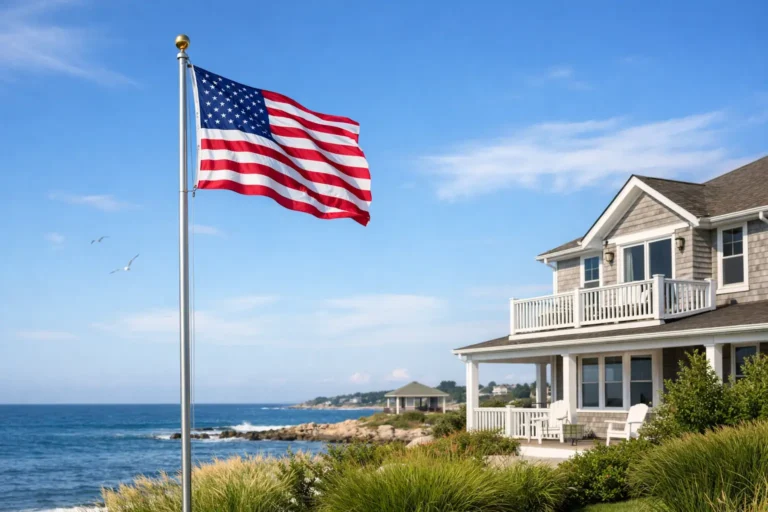
For most residential properties, the sweet spot is 20 to 25 feet. That height gives you strong curb appeal without making the pole look out of scale with the home. A one-story house often pairs well with a 20-foot pole, while a two-story house usually looks better with 25 feet. On larger homes with long setbacks or wide front lawns, 30 feet can be the right call.
For commercial buildings, schools, churches, and municipal properties, the range usually starts at 25 feet and goes up from there. A small office building may look right with a 25- or 30-foot pole. A school entrance, dealership, or town building may need 35 to 50 feet to create the visibility and presence buyers expect.
The key is proportion. In most cases, the flagpole should be taller than the main roofline if you want the display to stand out. If the top of the pole ends up visually buried by trees, signage, or the building itself, it will not deliver the effect most customers are after.
Start with building height and distance from the road
A good rule of thumb is to size the pole in relation to the structure beside it. For homes, the pole should generally complement the house rather than match it exactly. A 20-foot pole works well near ranch homes and modest colonials. A 25-foot pole often fits two-story homes better because it clears the visual mass of the roof and gives the flag room to fly.
Distance matters just as much as building height. If your home sits close to the street, a 20-foot pole can look more prominent than a 25-foot pole on a property with a long driveway. The farther the pole is from passing traffic or the main viewing area, the more height you usually need.
That is one reason there is no one-size-fits-all answer. Two homes with the same square footage can need different flagpole heights based on setbacks, landscaping, and where the pole will actually be installed.
Common residential flagpole sizes
For most homeowners, these ranges are a practical starting point. A 15-foot pole can work in a very small yard, but it usually feels modest and is better suited to tight lots or decorative use. A 20-foot pole is the most common residential size because it balances visibility, ease of installation, and cost. A 25-foot pole gives a stronger statement and often looks best with larger two-story homes. A 30-foot pole is usually reserved for estate-style properties, long setbacks, or buyers who want a more prominent display.
If you are between two sizes, it often comes down to whether you want the pole to blend into the property or stand out as a focal point.
What size flagpole do I need for a business or public building?
Commercial and civic properties usually need more height than first-time buyers expect. A pole that looks substantial in a catalog can look surprisingly small once it is placed in front of a parking lot, monument sign, or wide building facade.
For many small businesses, 25 to 30 feet is a strong starting range. That works well for professional offices, retail storefronts, and small churches. For schools, municipal buildings, larger churches, and multi-tenant properties, 30 to 40 feet is often more appropriate. Larger commercial campuses, car dealerships, and government installations may go well beyond that, especially when visibility from a distance is important.
There is also a presentation factor. A business entrance may call for one height, while a roadside display meant to draw attention from traffic may call for another. If the pole is competing with light poles, signs, trees, or a large roofline, a taller commercial-grade system may be necessary.
Match the flag size to the pole height
The flag and the pole need to be in proportion. A common guideline is that the flag length should be about one-quarter to one-third of the pole height. That keeps the display looking balanced and helps the flag fly properly.
A 20-foot pole often flies a 3-by-5 or 4-by-6 flag. A 25-foot pole usually pairs well with a 4-by-6 or 5-by-8 flag. A 30-foot pole typically takes a 5-by-8 flag, and taller commercial poles move into larger flag sizes from there.
This matters for more than appearance. An oversized flag creates more wind load, which puts extra stress on the pole, the hardware, and the foundation. If you live in a windy area, that trade-off matters a great deal. Sometimes a slightly smaller flag on the right pole is the smarter long-term choice.
Wind, exposure, and material can change the answer
A flagpole is not just a height decision. It is also a site-condition decision. If your property is open, elevated, coastal, or exposed to frequent strong winds, the right size may be limited by what the pole can safely handle.
That does not always mean you need a shorter flagpole. It may mean you need a stronger one. Fiberglass, heavy-duty aluminum, telescoping models, and high-wind designs each have their place, and the right pick depends on how often your site sees rough weather and how easy you want it to be to raise and lower the flag.
A 25-foot pole in a protected suburban yard is one thing. A 25-foot pole on an open rural property with constant wind is another. On exposed sites, buyers often need to think more carefully about wall thickness, taper, finish, hardware strength, and foundation requirements. This is where specialist advice matters, because the wrong choice can lead to avoidable wear, bent hardware, or a pole that simply is not rated for the conditions.
Installation space matters more than many people think
Before settling on height, look up and around. Trees, overhead lines, roof overhangs, and nearby structures all affect placement. You need enough open space not just for the pole in service, but for safe installation and future maintenance as well.
Taller poles also require more substantial ground sleeves or anchor systems, depending on the design. In some cases, a buyer chooses a 30-foot pole for appearance, then realizes the site is better suited to 25 feet because of access, excavation limits, or available clearance.
That is not a compromise if the result is a better installation. A properly placed pole that fits the site will usually look better and perform better than a taller pole forced into the wrong location.
A simple way to choose with confidence
If you are buying for a home, start with 20 feet for smaller one-story homes, 25 feet for most two-story homes, and 30 feet only if the property is large enough to support it visually. If you are buying for a business or public building, begin with 25 to 30 feet for smaller properties and move upward based on building scale, visibility needs, and site exposure.
Then ask the next practical questions. How far is the pole from the road? Will trees or the roofline block the display? Is your area windy? Do you want a standard residential presentation or a more prominent statement? Those details usually point you to the right answer quickly.
For buyers who want to get it right the first time, this is exactly where talking to a real flagpole specialist helps. At Bob's Flagpole Company, customers call for this kind of guidance every day because sizing is not just about what looks good in a product photo. It is about choosing a pole that fits your property, your flag, and your local conditions.
A flagpole should feel like it belongs there from day one - proud, balanced, and built to last. If you are unsure between two sizes, a quick conversation can save you time, money, and a second-guessing purchase later.