
Choosing a Flagpole for Business Entrance
Your front entrance says a lot before anyone opens the door. A well-chosen flagpole for business entrance areas adds visibility, strengthens first impressions, and shows pride in your property. It can also become a practical way to guide visitors, frame signage, and give your building a more established, professional look.
That only works when the flagpole fits the site. Too short, and it disappears against the building. Too tall, and it can overpower the entrance or create installation challenges that were avoidable from the start. For business owners, property managers, schools, and municipal buyers, the right choice comes down to a few real-world factors: scale, wind, materials, and how much maintenance you want to take on.
Why a flagpole for business entrance matters
At a business entrance, the flagpole is not just decorative hardware. It becomes part of the way people experience the property. Customers notice whether the entrance looks cared for. Tenants and visitors notice whether the site feels permanent and well maintained. For public buildings, a properly displayed American flag also carries a deeper sense of respect and civic pride.
There is a branding value here too. A clean, upright pole with a properly sized flag adds structure to the frontage of a building. It helps create a focal point without needing oversized signage or flashy design choices. For many properties, especially offices, dealerships, schools, churches, banks, and government buildings, that matters more than people realize.
Still, bigger is not always better. A flagpole near an entrance has to work with walkways, canopies, landscaping, parking flow, and overhead clearances. The best installation feels intentional, not cramped.
How to choose a flagpole for business entrance locations
The first question is usually height. For many small businesses and professional offices, a 20-foot to 25-foot commercial-grade pole is a strong starting point. It is tall enough to stand out near a one-story or modest two-story building, but not so tall that it dominates the entire frontage.
For larger buildings or wider setbacks, 30-foot poles often make more sense. If the entrance sits far back from the road, extra height helps the flag remain visible from the street. On the other hand, if the pole is being placed close to the building under a covered entry or near lower rooflines, a shorter pole may create a cleaner and safer fit.
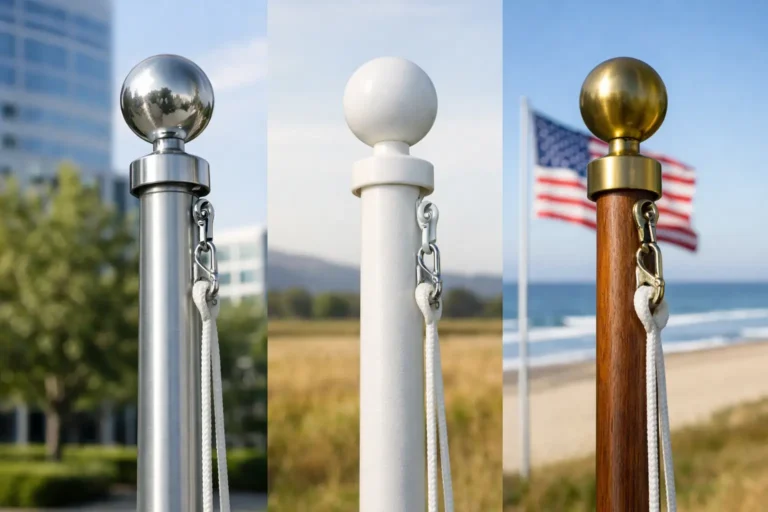
Material matters just as much as height. Aluminum is a popular choice for commercial use because it offers a clean appearance, solid strength, and low maintenance. Fiberglass can be an excellent fit in coastal areas or high-wind regions where corrosion resistance and flexibility are priorities. The right answer depends on the property and the environment, not just on appearance.
You also need to think about the flag itself. A larger flag is not automatically better if the pole height does not support it. An oversized flag can place unnecessary strain on hardware and create a look that feels out of proportion. A properly matched flag and pole will fly better and look better.
Matching pole height to building scale
A common mistake is choosing based only on product photos. What looks right in a catalog may not work at your entrance. Building height, setback from the road, width of the frontage, and surrounding landscaping all change the visual balance.
For a storefront in a retail strip, a towering pole may feel out of place. For a freestanding office with a broad lawn, a smaller pole may look undersized. If the entrance includes monument signage, columns, or formal landscaping, the flagpole should complement those elements rather than compete with them.
This is where specialist guidance helps. A true flagpole company will ask about roof height, wind exposure, and where the pole will sit in relation to the entrance. That leads to better long-term results than guessing based on a general hardware listing.
Wind exposure changes the decision
A flagpole installed at a business entrance often deals with more wind than owners expect. Open parking lots, corner lots, hilltops, and coastal properties can create steady gusts and funneling effects. That impacts both the pole and the flag.
If your site gets frequent high winds, it makes sense to choose a pole engineered for those conditions. That may mean stepping up to a heavier-duty commercial pole, fiberglass construction, or a design better suited to sustained exposure. It can also mean choosing a tougher flag made for daily outdoor flying rather than a lighter decorative option.
There is always a trade-off. Heavier-duty systems may cost more upfront, but replacing bent components, damaged hardware, or torn flags costs money too. For busy properties, reliability usually wins.
Placement and installation at the entrance
Where the pole goes is just as important as what pole you buy. Some entrances look best with a single pole centered in front of the building. Others benefit from a pole offset to one side, especially when the main walkway, driveway, or sign already creates a strong centerline.
The key is keeping the flag visible without creating obstacles. You need enough clearance from doors, sidewalks, parking spaces, and landscaping beds. The flag should have room to fly freely and should not strike the building, light poles, or tree branches.
Ground conditions matter too. Soil type, drainage, frost depth, and concrete requirements all affect installation. In many commercial settings, the foundation is not something to improvise. A properly set pole performs better, looks straighter, and lasts longer.
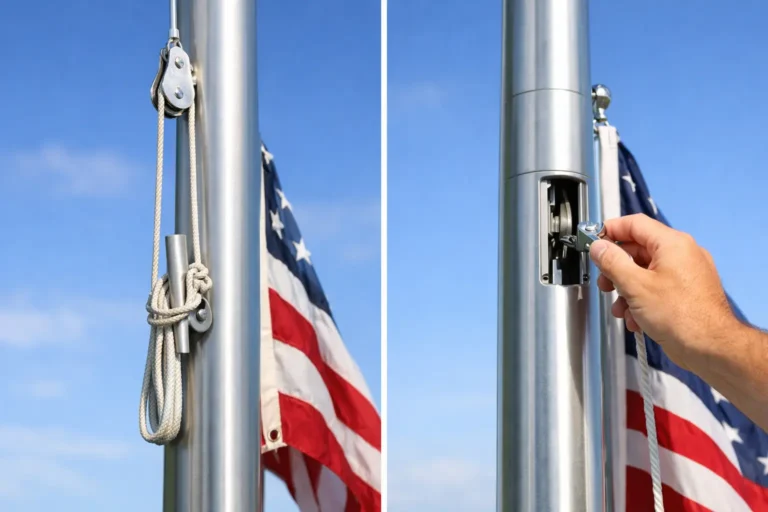
If theft resistance or noise reduction is a concern, especially near customer entrances, the hardware package deserves attention. Internal halyard systems offer a cleaner appearance and more security than exposed rope systems. External halyard setups can still work well, but they are not always the best fit for every public-facing property.
Lighting and code considerations
If the American flag will remain flying at night, it should be properly illuminated. For many business owners, that means planning for lighting from the start rather than treating it as an afterthought. Solar flagpole lights can be a practical option in some settings, while ground-mounted lighting may be better for others.
Local codes or site rules may also affect placement and height. Shopping centers, office parks, schools, and municipal properties sometimes have requirements tied to setbacks, underground utilities, or visual standards. It is better to check those early than to move the project later.
Common buying mistakes to avoid
The most common mistake is buying a residential-grade pole for a commercial entrance. A business entrance sees daily visibility, steady weather exposure, and higher expectations. A lighter-duty setup may save money at checkout, but it often falls short in appearance, performance, or lifespan.
Another mistake is underestimating maintenance. Some buyers focus only on the pole and forget the importance of quality hardware, durable flags, and access for raising and lowering the flag. If the system is difficult to use, the flag may not get the care it deserves.
Poor sizing is another issue. A pole that is too short can disappear against the building, while one that is too tall can look awkward and create unnecessary cost in foundation work and installation. The best result usually comes from balancing visual impact with site realities.
Finally, many buyers choose based on price alone. That makes sense on small purchases. On a commercial flagpole, it can backfire. A flagpole at the entrance is one of the first things people see. If it leans, rattles, corrodes, or looks undersized, it reflects on the property.
When expert help makes the difference
A good commercial flagpole purchase is rarely just about picking a number off a chart. It is about matching the pole to the property, the local weather, and the image you want the entrance to project. That is why many buyers prefer working with a specialist instead of a general seller.
For a first-time buyer, a short conversation can prevent expensive missteps. For experienced facility managers, it can confirm whether a replacement should match the old setup or whether the site would benefit from an upgrade. At Bob's Flagpole Company LLC, that practical guidance is part of what makes the process easier.
A flagpole for business entrance use should feel like it belongs there from day one. When the height is right, the materials fit the environment, and the installation is properly planned, the result is simple and strong. It welcomes people in, reflects pride in the property, and keeps doing its job year after year.