
How to Light a Flag at Night the Right Way
A flag that disappears after sunset is more than a missed curb-appeal opportunity. For homeowners, businesses, schools, and public properties that fly the American flag around the clock, proper illumination is the respectful choice. Knowing how to light a flag at night begins with one simple standard: the entire flag should be visible from dusk until dawn, not just a bright spot at the bottom of the pole.
The U.S. Flag Code states that the flag should ordinarily be displayed only from sunrise to sunset, but it may be displayed 24 hours a day when it is properly illuminated during darkness. That leaves room for different lighting methods, but it also means choosing a fixture with enough output, the right beam direction, and dependable power for your location.
What Proper Flag Illumination Looks Like
A properly lit flag is easy to recognize from the street or across a parking lot. The light should reach the full flag as it moves in the breeze, including the field of blue and the fly end. A fixture that only lights the lower edge of the flag, or a weak solar light that fades before midnight, does not do the job well.
Good lighting is also controlled. You want a focused beam that highlights the flag without shining into a neighbor's window, creating glare for drivers, or washing out the front of a building. The goal is dignified visibility, not the brightest possible light.
The correct fixture depends on your flagpole height, flag size, access to electrical power, surrounding trees, local weather, and how consistently you need the flag visible overnight. A small residential pole and a 40-foot commercial flagpole should not be treated as the same project.
How to Light a Flag at Night: Choose the Right Method
Most flagpole lighting falls into three practical categories: solar, low-voltage or line-voltage ground lighting, and pole-mounted lighting. Each has a place, and the best choice comes down to the site.
Solar flagpole lights
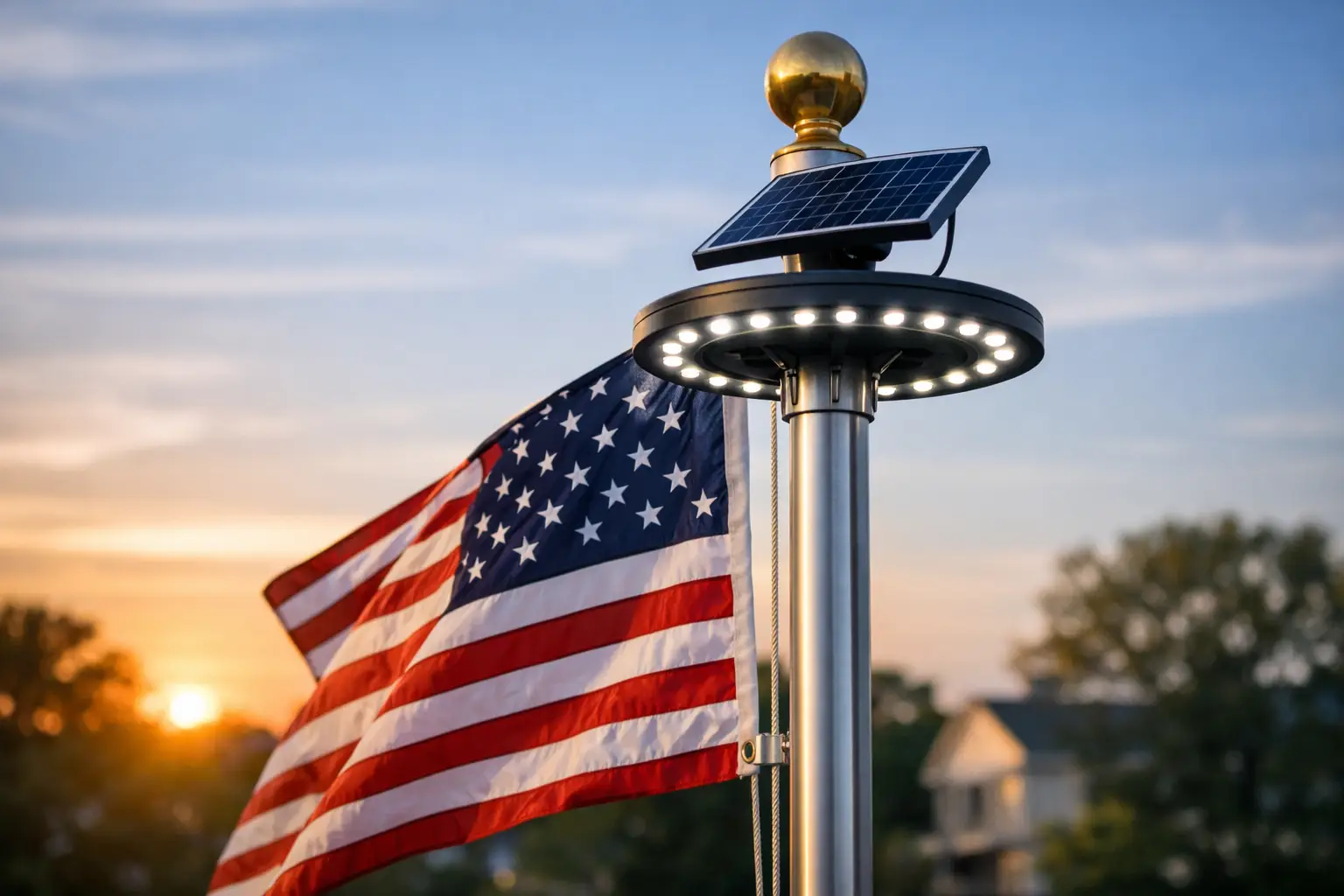
Solar lights are popular for residential flagpoles because they avoid trenching wire and can turn on automatically at dusk. Many mount near the top of a telescoping or sectional flagpole, directing light downward over the flag. Others are installed as solar spotlights at ground level and aimed upward.
A quality solar light works best where its panel receives several hours of direct sunlight. Before selecting one, look at the actual site, not just the weather forecast. A tall maple tree, roof overhang, or pole location on the north side of a building can sharply reduce charging time. In winter, shorter days and snow cover can also affect performance.
For a typical residential pole, a top-mounted solar flagpole light can be a clean, convenient solution. It is especially attractive when running electrical cable would disturb a landscaped yard or driveway. The trade-off is that solar performance depends on sun exposure and battery capacity. If your flag must be reliably lit every night, including during long stretches of cloudy weather, a wired fixture may be the better investment.
Ground-mounted spotlights
Ground-mounted fixtures are the traditional choice for larger residential, commercial, school, and municipal installations. One or more fixtures are placed at the base of the pole and aimed upward toward the flag. This approach provides strong, consistent illumination and makes maintenance easier because the lights remain at ground level.
For poles around 20 to 30 feet, two well-positioned fixtures often create a balanced presentation. Taller poles or larger flags may need three fixtures or higher-output equipment. The number matters less than coverage. The light should follow the flag's path as it moves, rather than creating a narrow, fixed beam that leaves half the flag dark.
Ground lights can run on low-voltage landscape systems or standard electrical service, depending on the fixture and required output. Low-voltage systems are a good fit for many homes, while commercial-grade poles may call for hardwired fixtures installed by a qualified electrician. Use outdoor-rated components, protect wiring from lawn equipment, and follow local electrical requirements.
Pole-mounted fixtures
Pole-mounted lights attach to the flagpole or an adjacent structure and aim toward the flag. They are useful when landscaping, concrete, traffic patterns, or a limited installation area makes ground fixtures impractical. They can also work well for wall-mounted flag displays where an existing building light can be directed properly.
The limitation is access. Any light mounted high on a pole eventually needs service, whether that means changing a battery, cleaning a solar panel, or replacing a fixture. On a tall one-piece fiberglass or commercial flagpole, maintenance can become a job for a lift or professional crew. Ground-mounted lights are generally easier to maintain over the long run.
Size the Light to the Pole and Flag
Lighting output should match the height of the flag, not simply the height of the pole. A 3-by-5-foot American flag on a 20-foot residential pole needs far less light than a 10-by-15-foot flag flying from a 50-foot commercial pole.
As a general rule, the taller the pole and larger the flag, the greater the light output and beam reach required. Fixtures also need the right beam angle. A beam that is too narrow can create a bright stripe and leave the flag edges in shadow. One that is too wide can spill onto the house, parking lot, or surrounding landscape.
LED fixtures are the practical standard because they use less power, offer a long service life, and produce strong light in a compact housing. Look for outdoor-rated fixtures with durable metal construction, sealed connections, and weather resistance suited to your climate. In coastal areas, choose corrosion-resistant materials. In high-wind regions, make sure both the light and its mounting hardware are secure.
Color temperature matters, too. A warm white light can feel inviting near a home, while a neutral or cool white light may provide crisper visibility on a larger commercial site. Avoid colored lighting for the American flag. Clean white illumination is the traditional and most respectful presentation.
Aim the Fixtures Before You Finish the Installation
The best fixture can still perform poorly if it is aimed wrong. Set lights far enough from the pole to allow the beam to spread across the entire flag. Then test the setup after dark while the flag is flying.
Start with the fixtures pointed toward the center of the flag's normal position. Adjust them gradually, checking for shadows on the stripes and uneven brightness at the fly end. If you are using more than one fixture, overlap the beams slightly rather than pointing all lights at the exact same spot.
Do not judge the result only while standing directly beneath the pole. View the flag from the street, driveway, entryway, or main public approach. This is where customers, visitors, and neighbors will see it. A well-lit flag should look clear and intentional from its primary viewing distance.
Plan for Weather, Maintenance, and Safety
Outdoor lighting works hard. Rain, wind, heat, ice, sprinklers, salt air, falling leaves, and lawn care all take a toll. Choose fixtures with a solid weather rating and inspect them regularly for cracked lenses, loose stakes, damaged wiring, or water intrusion.
Keep solar panels clean. Dust, pollen, bird droppings, and leaf debris can reduce charging performance more than most people expect. For wired systems, check that connections remain sealed and that cables are safely buried or protected. A ground-fault circuit interrupter, commonly called a GFCI, is essential for outdoor electrical circuits.
Also consider the flag itself. Lighting makes worn fabric more visible, not less. Replace a flag that is faded, torn, or badly frayed so the display reflects the same care you put into the pole and lighting.
When a Simple Solar Light Is Not Enough
Solar lighting is convenient, but it is not the automatic answer for every property. If your flagpole sits in shade, supports a larger flag, stands in a high-traffic business location, or represents a school, municipal building, or veterans organization, dependable wired lighting may be worth the added installation effort.
The same is true for high-wind installations. A larger flag can move well beyond the narrow coverage area of a small fixture, so stronger ground lighting and careful aiming become more important. For a new flagpole project, it is often easier and more affordable to plan the electrical work before concrete, landscaping, or pavement is complete.
A flagpole specialist can help match lighting to the pole, flag, and site conditions before you buy equipment that is too weak or difficult to maintain. At Bob's Flagpole Company, that kind of practical guidance is part of serving customers who want a display built to last.
A properly illuminated American flag remains a visible sign of respect long after the workday ends. Take a few minutes after dark to look at your display from a distance, make the final adjustments, and let the flag stand clear through the night.