
American Flag Size Guide by Pole Height
A flag that is too small can look lost on the pole. One that is too large can wear out faster, wrap badly in the wind, and put unnecessary strain on hardware. That is why an american flag size guide matters. Getting the proportions right gives you a better-looking display, better performance in weather, and a setup that feels right for your home, business, school, or public property.
If you have ever wondered whether to fly a 3' x 5' flag or move up to a 4' x 6', the answer usually starts with one thing - pole height. The general rule is simple: the length of the flag should be about one-quarter to one-third the height of the flagpole. That range gives you a strong visual presence without overpowering the pole.
American flag size guide for outdoor poles
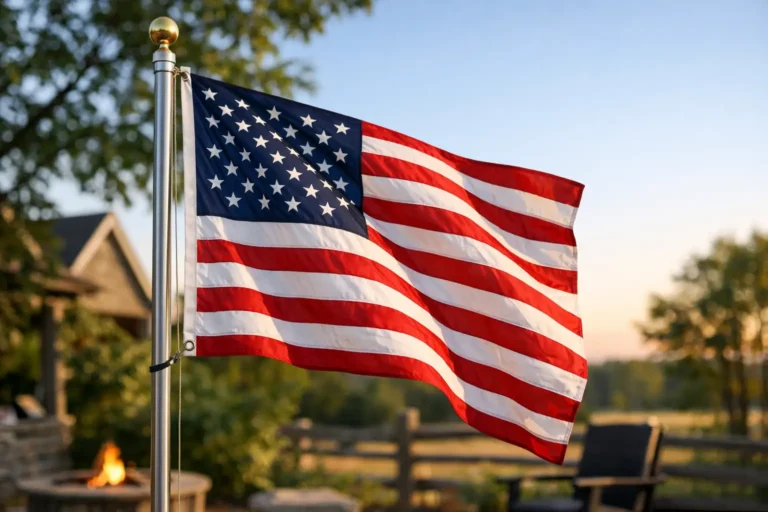
For most outdoor installations, these pairings are the standard starting point. A 15-foot residential pole usually looks best with a 3' x 5' flag. A 20-foot pole commonly flies a 4' x 6'. A 25-foot pole often pairs with a 5' x 8'. A 30-foot pole typically takes a 6' x 10', while 35-foot and 40-foot poles often need an 8' x 12'. Once you get into taller commercial and municipal poles, sizing becomes more site-specific, but the same proportion rule still applies.
Those are not random numbers. They come from years of standard flag use and from what works in the field. A flag should have enough size to be seen clearly from the street or parking area, but not so much that it becomes difficult to manage in normal wind conditions. Bigger is not always better if the pole, halyard, truck, and snap system are not sized for the load.
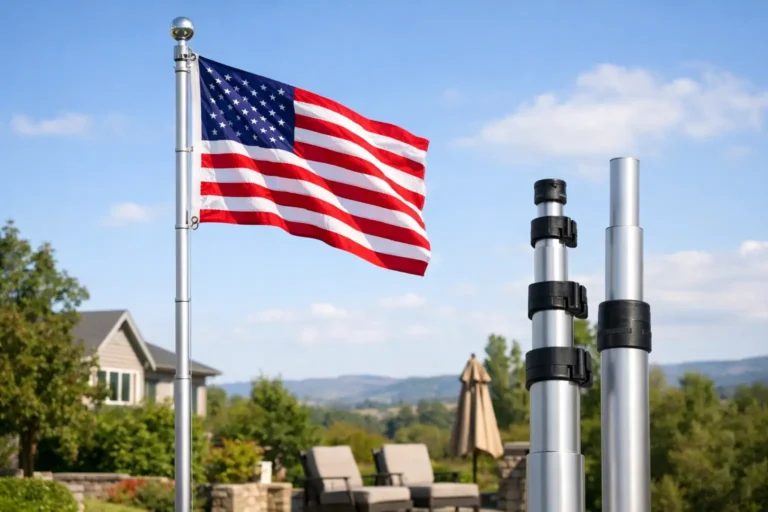
For homeowners, the most common question is around 20-foot telescoping and sectional poles. In most cases, a 3' x 5' flag gives a neat, traditional look, while a 4' x 6' flag creates a fuller, more prominent display. Either can be right. It depends on how open the site is, how strong your local winds are, and whether you prefer a more understated or more visible appearance.
Common flag sizes matched to pole height
A simple way to think about it is this: 15-foot poles usually take 3' x 5' flags, 20-foot poles take 3' x 5' or 4' x 6', 25-foot poles take 4' x 6' or 5' x 8', 30-foot poles take 5' x 8' or 6' x 10', and 40-foot poles usually take 8' x 12'. On commercial sites with 50-foot poles and above, larger flags such as 10' x 15' and beyond are common, but engineering and wind exposure matter much more at that level.
If you are between sizes, it helps to think about the property itself. A tight suburban lot with a 20-foot pole may look balanced with a 3' x 5'. A long driveway, larger yard, or roadside business may call for a 4' x 6' on that same pole.
When standard flag sizing is not enough
A good american flag size guide gets you close, but the real-world choice can still depend on conditions. Wind is one of the biggest factors. In high-wind regions, many customers do better with a slightly smaller heavy-duty flag than a larger standard-weight flag. That choice can reduce stress on the pole and help the flag last longer.
Visibility is another factor. A flag at a school entrance, church, dealership, or municipal building often needs to read well from farther away than a backyard display. In that case, moving up one size may make sense as long as the pole and hardware are built for it.
Then there is the question of daily handling. If you raise and lower the flag by hand, especially on a traditional rope-halyard pole, very large flags can be more awkward than many first-time buyers expect. On telescoping poles, it is still worth considering how much fabric you want to manage during changing weather.
Residential versus commercial sizing
Residential poles are usually chosen with curb appeal in mind. You want the flag to complement the house, not dominate the property. That is why 15-foot and 20-foot poles with 3' x 5' or 4' x 6' flags are so common.
Commercial and government sites are different. The flag is often part of a formal presentation, and scale matters more. A pole in front of a business entrance or public building has to hold its own against wider setbacks, larger architecture, and heavier traffic. That often means stepping up both pole height and flag size.
What about wall-mounted and house-mounted poles?
Not every American flag flies on a tall in-ground pole. Many homeowners use angled house-mounted poles near a porch, garage, or front entry. In that setup, the usual recommendation is a 2.5' x 4' or 3' x 5' flag, depending on the bracket size and how much room you have around the display.
A large flag on a short wall-mounted staff can look crowded fast. It may drag against siding, railings, shrubs, or porch columns. For most homes, a 3' x 5' flag is the upper end of what works well on a standard house-mounted pole.
Material and construction affect sizing decisions
Flag size is only part of the equation. The material matters too. Lightweight nylon flies nicely in light breezes and is popular for daily residential display. Polyester is heavier and often preferred for stronger wind areas, but it also puts more load on the hardware.
That means a 4' x 6' polyester flag may behave very differently from a 4' x 6' nylon flag on the same pole. If your location sees frequent gusts, stepping down in size while choosing a more durable material can be the smarter long-term move. That is especially true for open rural properties, coastal areas, and hilltop installations.
Choosing the right look for your property
There is a practical side to flag sizing, and there is also a visual side. Some customers want a clean, traditional presentation. Others want a bold display that can be seen from the road. Neither approach is wrong.
If your flagpole sits close to the house, garage, or landscaping, a more conservative flag size usually creates a balanced look. If the pole stands by itself in a wide-open yard or at the entrance to a business, a larger flag often feels more appropriate. The key is proportion. The flag should look intentional, not oversized for attention or undersized by accident.
A quick rule you can trust
When in doubt, start with the quarter-to-one-third rule. If the flag's length is roughly 25 to 33 percent of the pole height, you are usually in the right range. From there, adjust based on wind, visibility, and the type of property.
That simple rule helps eliminate most sizing mistakes. It also keeps you from buying a flag that looks fine in a product photo but does not perform well once it is actually flying on your property.
Mistakes people make when using an american flag size guide
The most common mistake is buying by flag size alone without checking the pole height. The second is assuming every 20-foot pole should use the exact same flag. In truth, a sheltered yard in town and a windy hilltop property may need different answers.
Another common issue is forgetting the hardware. A larger flag may require stronger snaps, better halyard components, or a pole designed for heavier use. That matters even more for commercial poles and for customers flying the flag every day.
One more thing to watch is replacing an old flag with whatever size you had before, even if the original setup was not ideal. If the previous flag always wrapped hard, looked too small, or wore out quickly, it is worth reassessing the size instead of repeating the same choice.
Getting it right the first time
Buying the right flag size should not feel like guesswork. Start with your pole height, use the standard proportional range, and then consider your location, wind exposure, and how visible you want the display to be. A 3' x 5' flag may be perfect for one 20-foot pole, while a 4' x 6' is the better choice for another.
That is where experience makes a difference. A specialist can help you think through the details that online charts miss, especially if you are comparing telescoping poles, traditional rope-halyard poles, or high-wind installations. At Bob's Flagpole Company LLC, that kind of guidance is part of the job.
A properly sized American flag does more than fit the pole. It honors the display, wears better over time, and gives your property the kind of presentation it deserves. If you are between sizes, trust the proportions, respect the wind, and choose the setup you will feel proud to fly every day.