American Flag Display Guide for Every Property
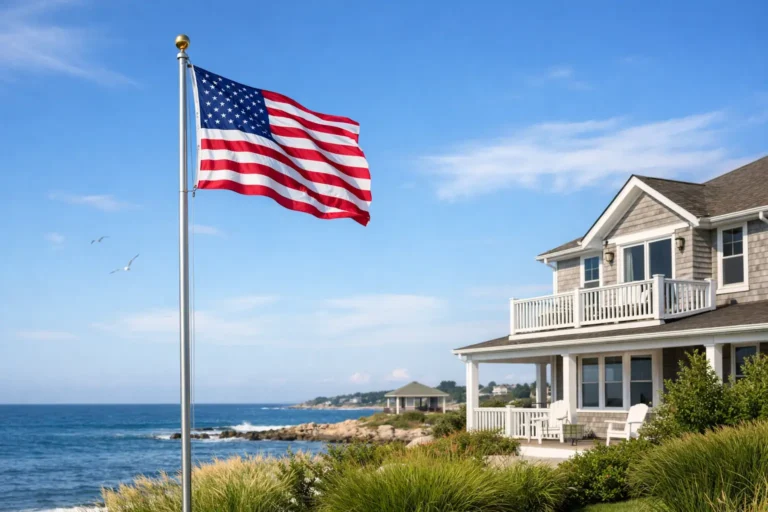
A flag that is too small for the pole, hung in poor light, or left to whip itself apart in heavy wind does not send the message most owners intend. The right american flag display guide is not about fussing over minor details. It is about showing respect, protecting your investment, and making sure the flag looks as strong and dignified as the country it represents.
At Bob's Flagpole Company, we talk with homeowners, schools, businesses, and public agencies every day who want to get this right the first time. Some are installing their first residential pole. Others are replacing worn hardware or upgrading to a stronger system after storm damage. In both cases, proper display starts with a few practical decisions that matter more than most people realize.
American Flag Display Guide Basics
The first rule is simple. The American flag should always be the position of honor. If you are flying it on a single pole, that part is easy. The flag goes at the top. If you are flying multiple flags on separate poles, the American flag should be on the highest pole or, when poles are the same height, in the most prominent position according to accepted flag etiquette.
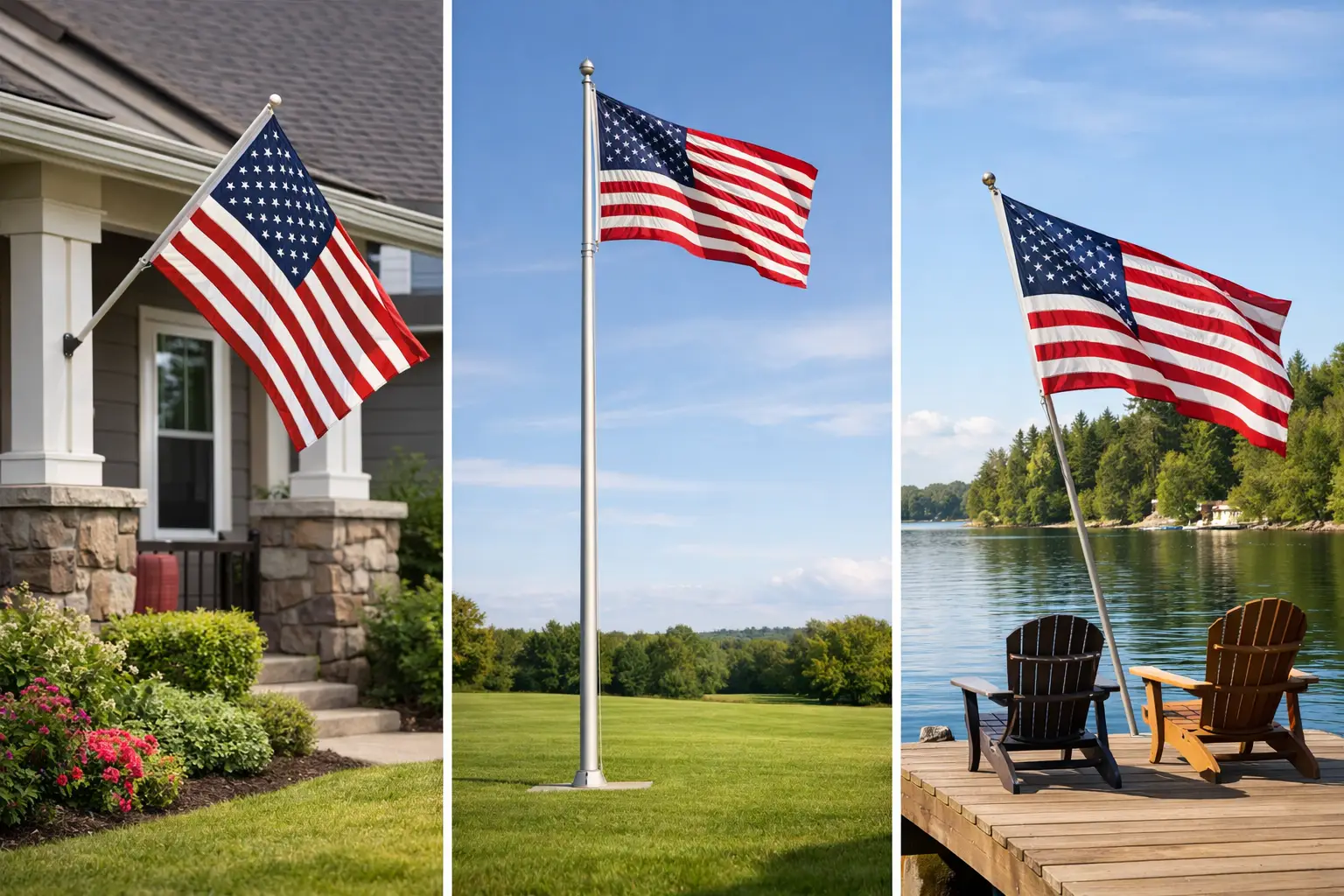
How you mount the flag also matters. On a house, if the flag is displayed from an angled staff projecting from a wall, the union, or blue field with stars, should be at the peak of the staff unless the flag is at half-staff. In a street display, the union should face north or east depending on the direction of the street. Indoors, when the flag is displayed against a wall, the union should be in the upper left from the observer's point of view.
These details may sound small, but they are the difference between a display that looks intentional and one that looks improvised. For schools, municipal buildings, and commercial properties, those details reflect directly on the organization.
Choosing the Right Flag Size for the Pole
One of the most common display mistakes is mismatching the flag and the pole. A flag that is too large can overpower the pole, wear out faster, and create unnecessary strain on the hardware. A flag that is too small can look lost, especially on a commercial site or open property.
A good rule of thumb is to size the flag to roughly one-quarter to one-third the height of the pole. On a 20-foot residential pole, a 3-by-5 or 4-by-6 flag is common. On a 25-foot pole, many owners prefer a 4-by-6 or 5-by-8. Larger commercial poles need larger flags, but local wind conditions should always be part of the decision.
This is where experience helps. A large flag may look great on paper, but in a high-wind area it can increase wear on clips, halyard, truck assemblies, and the flag itself. If your property sees steady gusts, the better choice may be a slightly smaller heavy-duty flag paired with a pole designed for the conditions.
Displaying the Flag at Home
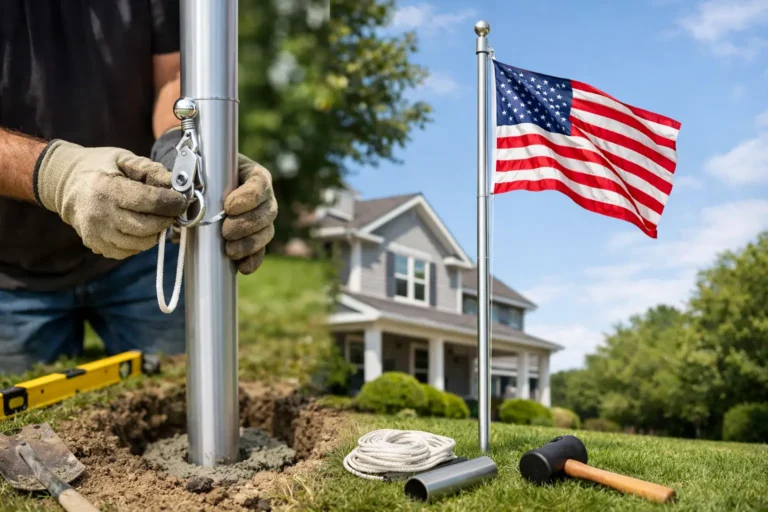
For homeowners, the best display is usually the one you can maintain consistently. A wall-mounted set is simple and traditional, but a freestanding pole gives the flag the presence it deserves and keeps it visible from more angles. Telescoping poles are especially popular for residential properties because they make raising, lowering, and changing flags easier without wrestling with ropes and pulleys.
Placement matters almost as much as the pole itself. The flag should be clearly visible from the street without interfering with trees, rooflines, or power lines. It should also have enough open space to move naturally. A flag pressed against branches or siding will wear faster and never look its best.
If you plan to fly the flag daily, think ahead about access. Can you lower it easily during storms? Can you reach the hardware safely? Can you illuminate it properly if you want it to remain up overnight? A good display is not just attractive. It is manageable.
Business, School, and Municipal Displays
Commercial and public-facing properties have a different set of priorities. The display needs to look formal, durable, and scaled to the site. A flag outside a business entrance should feel welcoming and professional. At a school or municipal building, it should project respect and permanence.
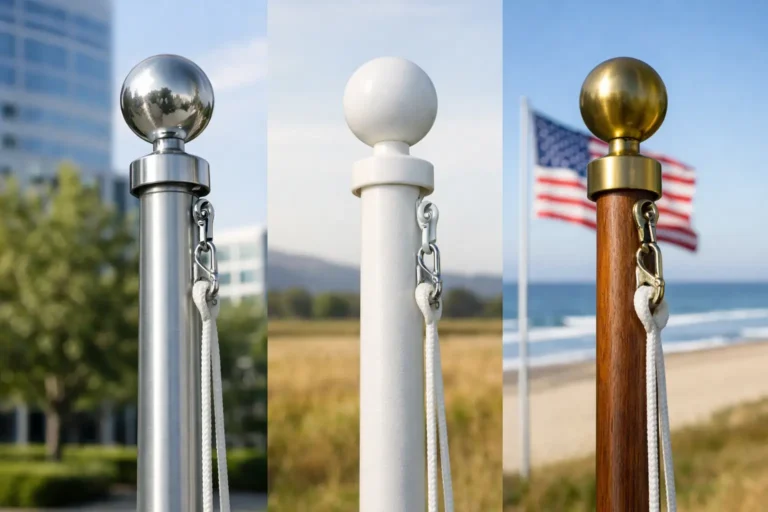
For these properties, pole height and placement deserve careful thought. A pole that is too short can disappear against the building. Too tall, and the display may feel out of proportion or become more difficult to service. Fiberglass and aluminum poles are often selected based on height, wind exposure, and appearance, while high-wind models are a smart choice in exposed areas.
There is also a maintenance side to public display. The larger the pole and flag, the more important it is to use quality hardware and replace worn components before they fail. A frayed halyard, bent snap, or faded flag stands out quickly on a school campus or government property. People notice.
Flying the American Flag in Bad Weather
A question we hear often is whether the flag should stay up in rain, snow, or heavy wind. The practical answer is that it depends on the flag, the pole, and the weather. Traditional guidance says the flag should not be displayed in inclement weather unless it is an all-weather flag. Many modern outdoor flags are made for regular exposure, but that does not mean every storm is a good idea.
Wind is usually the real issue. Strong gusts can shred even a heavy-duty flag and put stress on the entire system. If severe weather is coming, lowering the flag is often the best move. That is not a sign of neglect. It is part of responsible ownership.
This is one reason buyers in coastal areas, open farmland, and hilltop properties often need more than a standard setup. The right pole design, flag construction, and mounting hardware can save money and frustration over time.
Lighting and Night Display
If the American flag is flown at night, it should be properly illuminated. That can be done with ground lighting or with a quality solar flagpole light mounted at the top, depending on the pole style and site conditions.
The goal is not dramatic effect. It is clear, respectful visibility. The flag should be easy to see and evenly lit. Dim, partial, or unreliable lighting can make the display look neglected. For residential owners, solar lights are often the simplest option. For commercial sites, ground lighting may provide a stronger and more formal presentation.
Either way, check the setup after dark from several angles. What looks fine at dusk may disappear by full nightfall.
Half-Staff and Special Display Situations
Flying at half-staff is another area where people want clarity. The flag should first be raised briskly to the peak and then lowered to the half-staff position. Before lowering for the day, it should again be raised to the top before being brought down fully.
If you are displaying multiple flags and one is ordered to half-staff, protocol can get more nuanced depending on the arrangement. This is especially true for schools, municipalities, and government buyers. It is worth confirming the proper setup for your specific installation rather than guessing.
The same goes for paired displays with state flags, military flags, or organizational flags. The American flag remains the position of honor, but the exact arrangement depends on whether the flags are on one pole, grouped poles, a stage, or a building facade.
Flag Care Is Part of Proper Display
A proper display does not stop once the pole is installed. Flags need inspection. Look for fraying at the fly end, fading, torn stitching, and stress around the grommets or header. Replacing a worn flag promptly keeps the display looking right and honors what the flag represents.
It also helps to keep spare hardware on hand, especially if the flag is flown daily. Snaps, clips, and halyard components wear out over time. A beautiful flagpole setup can look poor in a hurry if one small part fails.
When a flag is no longer fit for display, it should be retired in a dignified manner. Many veterans' groups and community organizations can assist with proper retirement.
When the Best Choice Depends on Your Property
The strongest american flag display guide is the one that matches your site, not just the rulebook. A homeowner in a sheltered subdivision has different needs than a beachfront business, a courthouse, or a rural school with constant wind. That is why flag size, pole style, and hardware should be chosen together.
A display that looks excellent and performs well usually comes down to asking the right questions up front. How windy is the property? How often will the flag be raised and lowered? Do you want rope and pulley or a telescoping system? Will the flag stay up at night? How visible should it be from the road?
Those are not sales questions. They are ownership questions. Get them right, and the flag will look better, last longer, and require fewer repairs.
If you want the display to reflect pride in your home, business, school, or public property, take the time to match the flag, pole, and hardware to the real conditions on site. And if you are not sure what fits your property best, call Bob directly. A few minutes of expert guidance can save you from a setup that never quite looks or performs the way it should.